Saint Margaret’s Hope
In the first instance it should be noted there is genuine, published disagreement about whether Saint Margaret’s Hope is named after Margaret, Maid of Norway, or Saint Margaret of Scotland — and evidence exists for both.
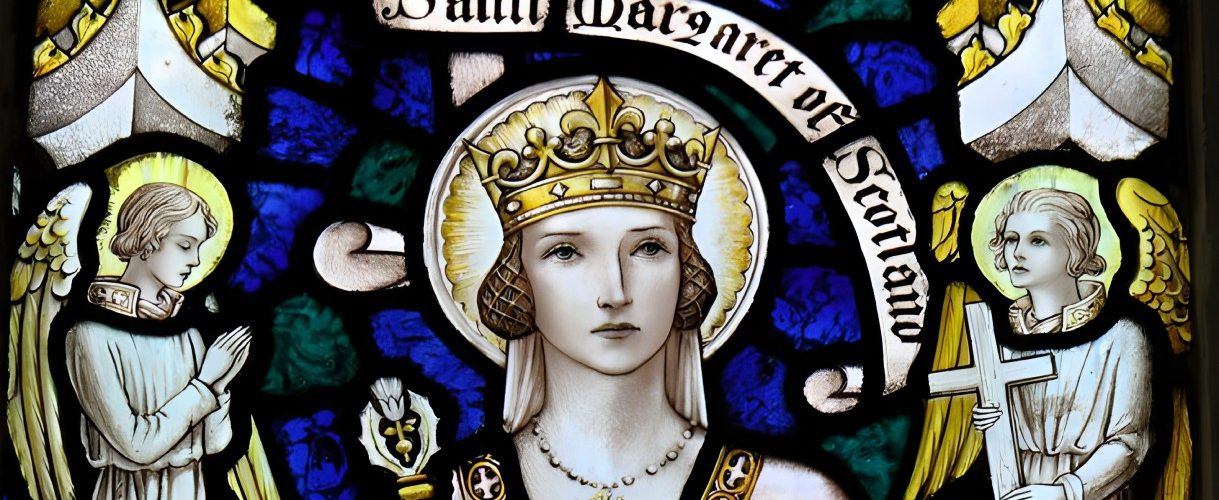
Saint Margaret of Scotland (c.1045–1093) was Queen consort to Malcolm III and was canonised in 1250 in recognition of her piety and the churches, monasteries and charitable works she founded across Scotland. A 1627 record of South Ronaldsay’s chapels lists “Sant Margrat in the Howp” — a chapel dedicated to St Margaret at the Hope — and Victorian Ordnance Survey maps mark the site of an early Christian chapel bearing her dedication nearby, though no trace of the building survives today. This is the strongest direct evidence linking the village’s name to her.
Margaret, Maid of Norway offers the more dramatic, and more directly Orkney-specific, story. As a child of seven, she was the recognised heir to the Scottish throne following the death of her grandfather, Alexander III. In September 1290, sailing from Bergen to Leith under the terms of the Treaty of Birgham to be crowned Queen of Scots, her ship was driven off course by storms into Orkney’s waters. She came ashore gravely ill, apparently from sea-sickness, and died here — by tradition, at or near what is now St Margaret’s Hope. She was never formally canonised as a saint, so if the village is named for her, the “Saint” in its name is an honorific rather than a formal title.
“Hope” itself is the Old Norse hóp, meaning a small landlocked bay or inlet — a common element in Orkney and Shetland place names, unrelated to either Margaret. This is quite nice, as the Orcadian nickname for The Hope is often pronounced as The Hop – very true to the origial Norse word.
As a Catholic parish, and given the documented chapel dedication, we lean towards Saint Margaret of Scotland as the more likely namesake — but the tragic death of the young Maid of Norway on these shores in 1290 is itself an important, well-attested piece of Orkney’s history, whichever Margaret ultimately gave the village its name.
Sources [1],[2],[3],[4],[5]
Saint Margaret of Scotland: Her Journey and Orkney’s Role in History
In the annals of Christian history, Saint Margaret of Scotland shines as a beacon of piety, compassion, and resilience. Born into Hungarian royalty around 1045, Margaret’s life took unexpected turns that ultimately led her to become Queen of Scotland. Her story intertwines with a pivotal event in the remote and rugged landscapes of the Orkney Islands, a place marked by both natural beauty and spiritual significance.
The Early Years and Perilous Voyage
Margaret’s early years were fraught with turmoil as her family fled their homeland due to political upheavals. Seeking refuge, they embarked on a treacherous journey across Europe, seeking safety and stability. It was during this tumultuous time that fate, guided by divine providence according to Catholic belief, steered Margaret’s ship off course.
The precise details of where Margaret’s ship was blown off course vary in historical accounts, but many traditions hold that the ship found itself in the turbulent waters around the Orkney Islands, likely in what is known today as Saint Margaret’s Hope in Orkney. These remote islands, situated off the northeastern coast of Scotland, were notorious for their unpredictable seas, the swelkie, and harsh weather conditions. Yet, it was here, amidst the swirling mists and crashing waves, that Margaret’s life intersected with the fate of Orkney.
Orkney: A Crucible of Faith
Orkney, in the early 11th century, was a rugged outpost on the edge of the known world. Its inhabitants, steeped in Norse mythology and traditions, lived a life intimately connected to the sea and the land. The arrival of Margaret and her entourage, strangers from distant lands, must have been a startling sight. Yet, it was also a moment charged with significance, for it marked the beginning of a transformational encounter between their pagan beliefs and the teachings of Christianity.
Margaret’s Influence and Legacy
Margaret’s time in Orkney, albeit brief and marked by hardship, left an indelible mark on both her and the islanders. Legend has it that Margaret, despite the challenges of her journey, maintained her faith with unwavering devotion. She is said to have prayed fervently during the storm that had brought her ship astray, seeking divine guidance and protection for herself and her companions.
Her steadfast faith and her eventual arrival in Scotland, where she married King Malcolm III and became Queen, set the stage for a remarkable chapter in Scottish history. Margaret’s deep piety and commitment to Christian virtues transformed the Scottish court and the wider kingdom. She established churches, monasteries, and charitable institutions, promoting education and welfare amongst her people.
Orkney Today: A Testament to Saint Margaret’s Journey
Today, the Orkney Islands stand as a testament to Saint Margaret’s journey and the enduring power of faith. The landscape, though changed by time, still echoes with the whispers of history and the trials faced by Margaret and her companions. The Catholic community in Orkney, though small, continues to honour her memory and the role the islands played in her remarkable odyssey.
Saint Margaret of Scotland was canonised in 1250, recognising her holiness and the profound impact she had on the spiritual and cultural landscape of Scotland. Her feast day, celebrated on November 16th, serves as a reminder of her legacy of compassion, humility, and unwavering faith.
Margaret’s unexpected journey through the waters around Orkney serves as a poignant reminder of the mysterious ways in which faith and providence intertwine. Her life, marked by trials and triumphs, continues to inspire countless believers around the world, reinforcing the enduring power of faith and the transformative potential of a life lived in service to others.
Saint Margaret of Scotland’s story, intertwined with the rugged beauty of Orkney, stands as a testament to the resilience of the human spirit and the enduring power of faith in guiding us through life’s storms. The ancient church of Saint Margaret, in South Ronaldsay, is detailed in CanMore.